Venus de Milo: pose, meaning and missing arms
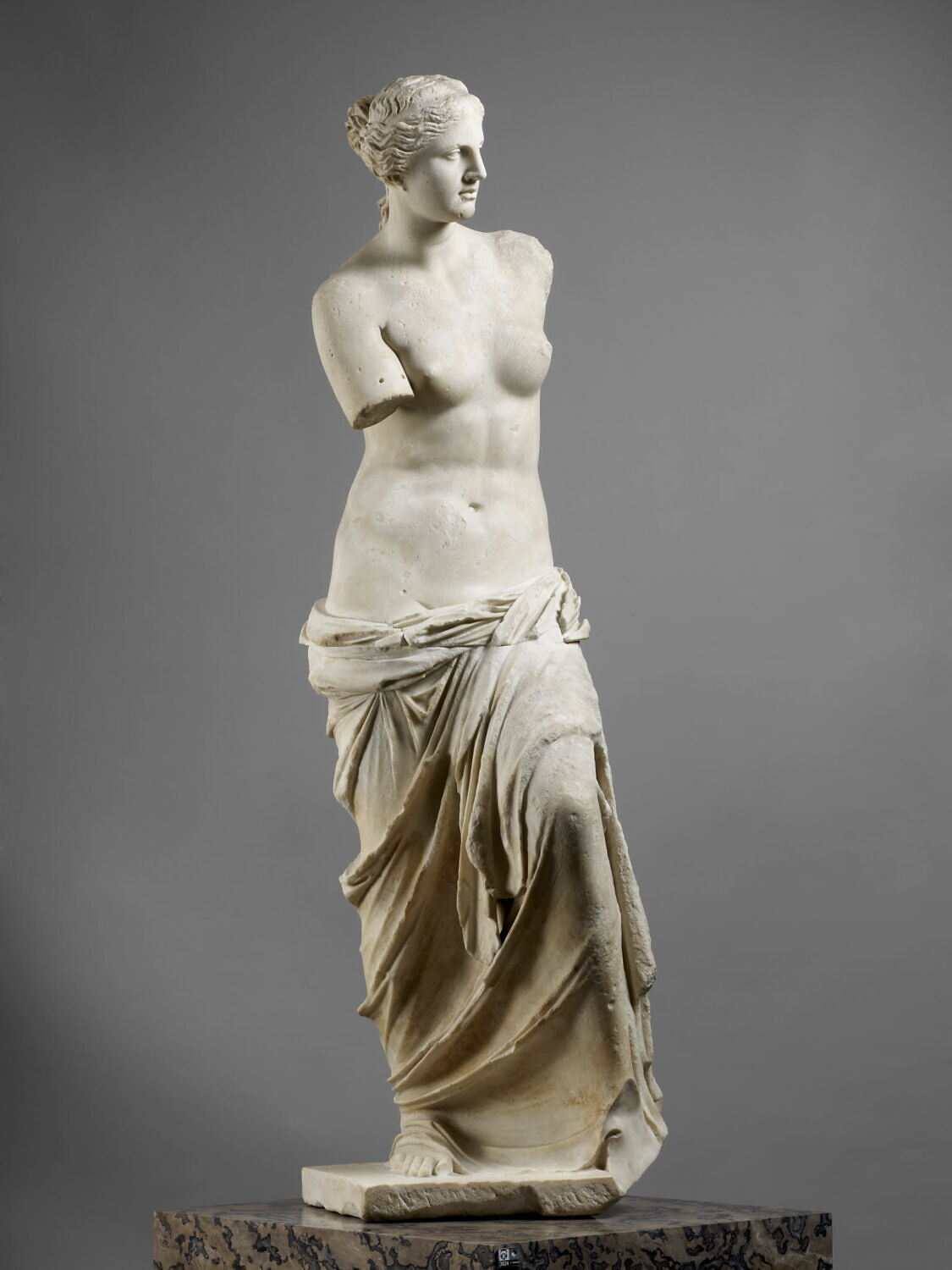
The Venus de Milo is a Hellenistic marble statue usually understood as Aphrodite, the goddess of love. It was found on the island of Melos in 1820. Its missing arms shape the way we see it today, but do not allow a certain reconstruction of the original gesture.
Why the pose matters
Start at the shoulders and compare their direction with the hips. The figure does not stand before you as a perfectly symmetrical block. The body appears to turn while the garment gathers the lower half. You may notice both stillness and movement. This is a way of looking, not proof of a particular action.
Reading the marble
Compare the smooth upper body with the deeper folds of cloth. The folds cast different shadows from the skin. Although both are stone, the carving suggests different surfaces. Move your viewpoint slightly and notice how those contrasts change.
What remains uncertain?
Imagine the arms in two different positions. How does the effect change? The missing parts reveal how much a gesture can contribute to a figure’s meaning. An imagined completion is not a securely established reconstruction.
Artwork record and source
An original Louvr introduction, created with AI assistance. Artwork facts checked against the linked museum catalogue. Interpretations are suggestions for looking. Check the catalogue for the current display location.
Musée du Louvre ↗